INDONESIA TRIP REPORT
- JULY 3-13, 2026
(Click here to see
some pictures from
this trip plus links to the SmugMug slideshow.)
As best as I can tell, this was our 12th trip to visit North Sulawesi,
Indonesia, and dive with our good friends at Murex Dive Resort in
Manado. When I’m setting up trips, the age-old quandary is whether we
should go back to places we’ve been or should we find new destinations.
the argument for repeat visits are that they know what to expect from us
(so we usually get pretty good treatment), we have some level of
knowledge of the place and can make sure we go to the “better” spots, we
have a sense of what the pitfalls may be and can hopefully avoid them,
and (since we usually include the tip is our trip prices) the resort
already knows we’re pretty good tippers and that makes for better
attention and service as well. And for all of those reasons and more, we
were happy to have Murex on our sked for 2026.
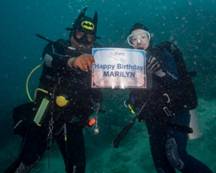
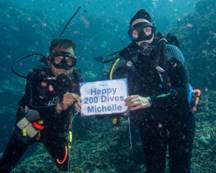
We had 13 divers on this trip: Marilyn Lawrence (celebrating her 80th
b-day during the trip), Michelle Leonard (celebrating her 200th dive
during the trip), Gayle Chin, Tony Hanna, Rik Aceves, Paul Weers and his
non-diving wife Vas, Stuart Berryhill and his adult daughters Hayley and
Heather, Audrey Anderson, Vanessa Richardson, and me (Ken Kurtis). About
half the group had done this trip before and was eager to do it again,
which sort of validates the idea of going back to places we’ve already
been.
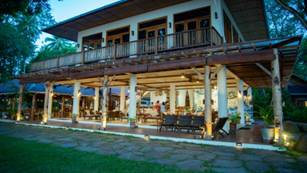
The last time we were here was in 2024 and I was very excited to see
Murex Manado again because they’ve done some major reconstruction in the
past 24 months. They’ve gutted and rebuilt a couple of their rooms, they
tore down the old camera room and built a gorgeous new bar/lounge area
with a meeting room on the second floor, they redid the entire
office/reception and dive shop areas, and - best of all IMHO - the built
a brand new spacious camera room.
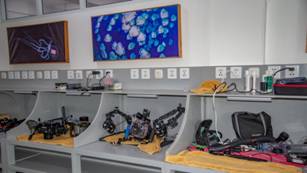
Needless to say, the camera room addition was very exciting for me. The
old room was more like a closet. Cramped, and hard to fit more than six
people and their gear in there. The new rooms is spacious, airy, lots of
room to work, a dozen or more (I didn’t do an exact count) camera
stations all with multiple international charging outlets, and ceiling
fans to keep the air moving but no air conditioning since that can cause
the lenses and housings to fog up. They did a really nice job.
In fact, the whole place is gorgeous. They’ve effectively rebuilt the
entire resort in the last ten years or so. They’ve always been looking
to make little improvements but this is really above and beyond. And the
improvements aren’t confined just to the resort.
They’ve also built a new boat, the Galaxea, which is slightly larger and much faster than their other boats. It was perfect for our group of 12 divers, especially since we dove as three different groups of four for each dive. Best of all, each group had their own dive guide. We tried to space the groups out a bit with the entries, but when you’re all heading in the same direction and the first group finds something special (a Ghost Pipefish for example), they want to share that find with the other groups and then it can seem to get a bit crowded. Not ideal, but we managed.
And we want to shout the praises of our three dive guides: Basrah Tan,
Bernard, and Reymon (I don’t have last names for Bernard and Reymon).
I’ve been diving with Basrah for about 20 years and to say we’ve
developed a comfort level and rapport would be an understatement. I
don’t think we’ve dove with Reymon before but he was wonderful as well.
And I was quite happy to see Bernard back in the Murex fold, as he was
the first guide I dove with at Murex in 2000. In fact, he’s the one who
gave me my beloved “Opa Gila” nickname.
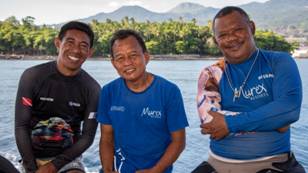
I don’t know how old Bernard is now but I’m guessing when I first met him 25 years ago, he was around 30-35. In Indonesia, “Opa” is actually a term of respect for an older male. (The female equivalent is “Oma.”) Back then, the very young kids working as boat crew got a kick out of calling Bernard “Opa Bernard.” They thought that was the funniest thing ever. And after we’d been there a while and they got to know us, one of them asked Bernard what they’d call me. He thought about it for a minute and said “Opa Gila.” They also laughed heartily so I asked him what it meant. “Crazy Old Man” is the loose interpretation. Terribly insulting but it has a nice lilt to it and I liked the way it sounded. And they all started call me “Opa Gila”. And the name has stuck for over a quarter century. (I even had a personalized license plate that said “Opa Gila” on one of my cars.)
But maybe we should get on to talking about the diving.
We ended up doing 28 dives over the course of our nine dive days with Murex. It’s important to understand that they have three resorts: Murex Manado, Murex Bangka, and Lembeh Resort (where they only run/own the diving and photos ops). Their big thing is called “Passport to Paradise” where you spend three days in Manado, then three days in Bangka, and finally three days at Lembeh. I’m not too nuts about that because I don’t like the idea of packing up and moving every couple of days, even though they move all your stuff for you (you still need to pack it up though) and the transfer is by boat so you dive along the way. But the diving at each of the three resorts is definitely different and worth exploring.
What we do, and have done every time we’ve been there, is make Manado our home base (I’ve always felt that’s the crown jewel resort anyhow). We then do a day trip by boat to Bangka (with lunch at the resort there) and a day trip to Lembeh, which involves driving to Bitung and then a Lembeh boat picks us up there for three dives in the Lembeh Straits with lunch at the Lembeh Resort. It’s a sked that works for my groups - I’ve pitched them for years on offering it formally and calling it the “Opa Gila Special” - and I appreciate that they’re willing to accommodate us.
Each resort has advantages and some disadvantages. In Manado, we get great walls and corals over at Bunaken Marine Park (about a 30-minute run away) as well as muck sites (cool unusual critters but lower viz). So a lot of days we’d do two dives at Bunaken, come back to Murex Manado for lunch, and then do a close-in Manado Bay muck site. (And a few days we stayed out for all three dives with a nice full lunch on the boat.) Bangka Island has some of the most beautiful soft coral reefs I’ve ever seen but if the wind starts blowing, you can’t get to a number of the dive sites and have to go around to the back of the island. In fact, the day we journeyed there, that was the case so we couldn’t dive Sahong, a spectacular reef, but chose a good alternative. And in Lembeh, the focus is on the unusual critters found there (Mimic octopus, Pygmy Seahorse, Frogfish galore, nudibranchs and more) but that may also mean you’re competing with some photog from another boat who has decided to spend their entire dive trying to get the perfect shot of a specific critter. So I’ve always been happy with our mixed bag of locations.
Our general sked each day was two dives, lunch, third dive, then back at the resort. You could do an optional late afternoon house reef dive but no one took advantage of that. The basic day started at 7:00AM with breakfast (coffee and tea were available earlier than that), our boat left anywhere from 7:45-8:15AM depending on where we were going, many days we came back to resort for lunch around 1:00PM, and then the afternoon dive was around 2:45PM. Travel time to Bunaken Marine Park for the morning dives was 30-45 minutes. For the afternoon Manado Bay muck dives, travel time was as little as five minutes. There were also two night dives offered which left at 6:15PM. Dinner was served at 7:00PM and most people went back to their rooms around 8:30PM-ish. Personally, I would tweak pix and try to be in bed no later than 10:30PM because I’d wake up around 5:30AM each day to start anew. For me at least, it’s actually a fairly busy schedule each 24 hours since I’m also conferring with Basrah as to where we’re going to go, finding out if everyone’s doing the dives that day, prepping my cameras, checking e-mails, and stuff like that. I joke that it’s really work for me so I need a vacation after my “vacation.”
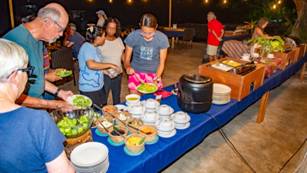
I thought
the food was pretty good and there was always a wide variety of things
to choose from. Breakfast was typical morning stuff with rice or
noodles, eggs to order, bacon, toast, veggies, fruit, and some other
choices. Lunch and dinner were always buffets with soup and salad
options, plenty of variations of rice and noodles, vegetables, and
usually a meat or pork, a chicken, and a fish dish, plus dessert. They
also do a “Live Cooking” at the end of the buffet line at all meals with
one of the chefs there to do the honors. Each lunch or dinner offered
different things like pasta, dim sum, and even hamburger and fries one
evening. You weren’t going to go hungry and I was scared to step on my
scale when I get home.
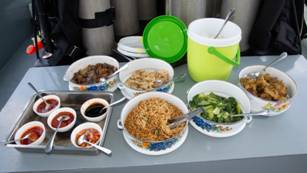
Even days
we had lunch on the boat, it was a complete offering. The food was
prepped in the morning and was generally luke-warm to room temp by the
time we ate (which was fine) and consisted of rice, noodles, vegetables,
fish, and either chicken/beef/pork as well. Again, no one went hungry.
Overall this time, we had a mixed bag of diving conditions (which is certainly not the fault of Murex). I seem to recall that when we first came in 2000, we had numerous dives where the viz approached 100 feet. Not so this time. Although we had one dive like that, most of the dives were in the 40-60 foot range, with a fair amount of particulate in the water, which makes things tough if you’re photoing or videoing. By the same token, this is a comment I seem to be making more and more in my travels around the world. Maybe this is just the way things are &/or a by-product of climate change. I truly don’t know. But the days of saying the water is “crystal clear” seem to be less and less.
Water temps were a comfy 85-87º degrees most of the time. (Air temps were generally in the mid-to-upper 80s.) I personally wore a 1mm suit with a 1mm hood. Some people dove in just their swimsuits, others used a 5mm suit, and then we had everything in-between. I’m always an advocate of “more is better” when it comes to thermal protection because if you’re wearing too much, you can always let water in to cool down. But if you’re not wearing enough, you’ll be kicking yourself for not wearing something thicker.
Although I also had a 3mm suit with me (never wore it), I deal with temp changes by using thicker Tilos hoods. I have a fabric 1mm, a neoprene 1mm, and a neoprene 3mm hood. If I’m getting cold, I start by going to a thicker hood. I wore the 1mm neoprene for all the dives except the three in Lembeh where the water temp was 81-82º, so I opted for the 3mm hood which was perfect (and doesn’t change my buoyancy so the weights stay the same).
We did run into occasional pockets of cooler water and it was sort of funny to hear people commenting on it. Normally, if I told you I could put you in 82º water, you’d be thanking me. But when you’re gotten used to 85-87º, running into 82º does indeed feel “cold”.
To my eye, the corals seemed pretty healthy. Anytime I dive, I’m always on the lookout for bleached parts of the reef and I only saw one small coral that was bleached white. That’s pretty good. At the resort, I was talking with a coral researcher from Ocean Gardener and she said that it seems that the corals in this area have become fairly thermal resistant. So what they’re trying to do is take some of those corals and transplant them in other areas to see if that thermal resistance holds. I asked her if some of the Manado coral species exist in other places and if they do, why are they more heat-resistant in Manado than elsewhere? She agreed that was an interesting angle to investigate.
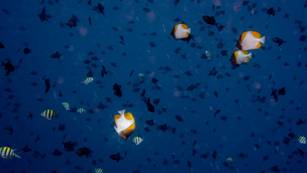
Fish life
was also plentiful too. On every dive, especially the wall dives, a
glance out into the blue revealed thousands upon thousands of
Red-Toothed Triggers (the bluish-purple fish), Pyramid Butterflyfish,
and (up in the shallower areas) numerous Sergeant Majors. Really nice to
see so many. We also had large schools of Black Snappers, Orbiculate
Spadefish, and even some Barracuda.
Speaking of which, we did a dive at Mantehage Island (a bit further north than they normally go) at a spot called Barracuda Point. Basrah said that it’s so named because there’s a large school of Barracuda that hang out there. Not on the day we went. No Barracuda Point was a better name for it. (Although the drift down the wall was really nice.) We decided that perhaps a better name for the place would be “If You See a Barracuda, Please Point.”
Speaking of drifting, you will get currents when you dive this area of Indonesia. These aren’t going to be rip-roaring currents like you might get in the Maldives or at Peleliu Express in Palau and you don’t need a reef hook. But the currents will occasionally start in one direction and then seemingly switch direction. This is because of the way the currents come in and hit the walls and then form little eddies or even splits. So once you realize you’re swimming into the current instead of the current pushing you along from behind, you either turn around to get the current behind you again, or decide to keep going forward to see if it gets stronger or even switches yet again further along.
We did one
dive (at Lekuan 2, I think) where our group was just Basrah, Audrey, and
me. Lekuan is well-known for turtles that glide in looking for a ledge
so they can take a nap, so we made this a “count the turtles” dive. (I
was videoing and came up with 28, Audrey counted close to 40, and Basrah
claimed almost 60.) The current started behind us and then switched.
Basrah made a motion to turn around, but I said we should plow ahead,
especially since it was just three of us and we all have pretty strong
kicks. And that’s what we did. So, especially since all the other divers
reversed course, we had the reef (and the turtles) to ourselves. Audrey
said, and she was sincere, that that was one of her favorite dives ever.
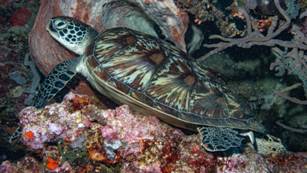
Speaking of turtles - and you’ll see plenty of them, especially at Bunaken - we got to observe in a special turtle experience at Murex Manado that was conservation-minded as well.
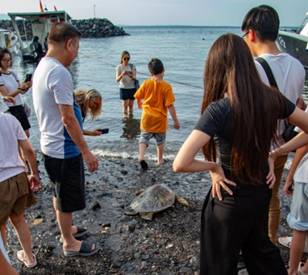
Murex has long been at the forefront of conservation in Manado. The resort was founded by Dr. Han Batuna and he lobbied hard for the creation of the Bunaken Marine Park (a protected area) many years ago. After he died, his daughter Angelique and her American-born husband Danny Charlton, took over the resort and have continued with the conservation theme. They work with many NGOs doing coral research, fish counts, and the like. So it was no surprise to hear that the beach at Murex Manado is the site for releasing turtles back into the wild.
Because
there are so many turtles in the area, they are inadvertently caught in
fishermen’s nets and sometimes injured as well. A local Chinese family
has offered to buy those turtles from the fishermen so that they can be
released back into the water, rather than have the fishermen sell the
turtles to a market. On one of our days at Murex, there was a turtle
release happening in the late afternoon. There were eight turtles
involved, two Hawksbill and six Green turtles, all adults. The turtles
were brought over in the back of a small truck and the Chinese family
was there to facilitate. They started by gathering around the truck and,
in Chinese, started a song/chat for the good health of the turtles. Then
they each took one of the turtles from the tuck, walked it down to the
water’s edge, did a laying-of-the-hands on the animal (good luck for the
turtle as well as for them), and then stood back. A couple of the
turtles took off like as shot when they realized they were in water
while a couple of them seemed dazed with a look of “What the hell is
happening” on their faces. All of the turtles made their way back into
the ocean and have hopefully resumed a normal turtle life.
What the entire Manado region is well known for, on just about every dive, are small things. There are tons of nudibranchs. The wall dives produce things like Orangutan Crabs nestled into Bubble Corals, Leaf Scorpionfish along with “regular” Scorpionfish, various species of Parrotfish and Snappers, the occasional Map Puffer, all kinds of Butterflyfish, Anthias, Blennies and Gobies, along with plenty of anemones with resident Clownfish (aka Anemonefish).
The muck dives offered the most unusual creatures but perhaps I need a definition of terms first.
Here’s the
Google AI-generated definition: “Muck
diving is a scuba experience where divers explore loose sedimentary
bottoms—like mud, sand, silt, or coral rubble—rather than vibrant coral
reefs. Though the scenery looks desolate, these "mucky" bottoms are
havens for rare, exotic, and bizarre macro marine life, making it a
favorite for underwater photographers. Unlike standard reef diving,
where you take in expansive views of scenery, muck diving requires
patience, a slow pace, and a sharp eye for "critter hunting". You are
essentially looking for tiny masters of camouflage hiding in the
sediment.”
Muck dives are done over normal
white sand or sometimes black volcanic sand, which has a much finer
grain and is more easily disturbed and silt up. No matter where you are,
buoyancy is key because once you stir the sand up, it may take a little
while to settle back down. But in both cases, the sand might be bordered
by some scattered corals or even a mini-wall, or it may just be sand
unto itself. But in that sand, if you know where to look (or if you pay
attention to your guide), live some most unusual creatures.
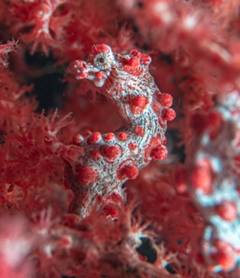
The Lembeh
Straits are known as the Mecca of Muck Diving. It’s also very
critter-focused. People will go to resorts there for a week or more with
a list of the animals they want to find. Among the animals we found this
trip were the Pygmy Seahorse, teeny-tiny seahorses, about the size of a
grain of rice, which live on a specific type of seafan and blend in so
well that it’s hard to distinguish them from the seafan on which they
live.
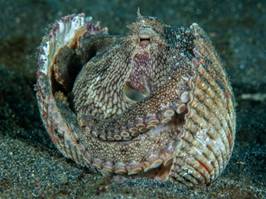
Another
popular animal to find in Lembeh is the Coconut Octopus. This is a
medium-sized octo who gets its name because it looks for abandoned
coconut shells, takes two of them, gets in the middle, and then uses its
suckers to draw the shell halves together while it stays inside,
offering both protection as well as a hiding place from which to pounce
on something edible. And when they can’t find a coconut, they improvise.
Sometimes they might find two clam shells and make due with that. We
even saw one - and you’ll see this in the SmugMug slide show - who took
maybe five or six pieces of broken clam shells, got in the middle, and
then drew all the pieces together to make an improvised home. Pretty
clever animals.
When you’re looking for small hard-to-find creatures, you then need to make sure that everyone in the group gets a chance to see them. That’s not always easy when something like a Mantis Shrimp might spook and duck back in its hole or a Cuttlefish might scurry away.
At Reef Seekers we’ve long had a “3 or 30” rule which means you can take 3 photos or spend 30 seconds with a critter, and then need to give someone else a turn. For Murex, especially in Lembeh, the guidance is that those without a camera go first, then the small cameras, then the medium cameras, then the big cameras. It all seems fair on paper but in practice, where you have the dive guide searching the bottom, a photog staying on his heels, another diver slightly out in the blue, another one hanging back, and another shallower/higher than the guide, it’s sometimes harder to implement. But in general, everyone on our trip seemed pretty good about trying to make sure that others in their group of four got a glimpse. And the guides were good about letting the other guides know when and where they found something.
A final stroke of good fortune for us was that we had pretty good weather every day, except for some wind at Bangka and Lembeh which simply put a couple of sites off-limited. But good weather always helps make everything more enjoyable. There was only one period of extended rain and that started late one afternoon after we were back at the resort when it rained fairly steadily for about three hours. Unfortunately, it happened on July 4, which was also the evening Murex had planned a major 4th of July celebration, having invited a number of American ex-pats in the area to come over and there were even fireworks planned. Although this was all to be outdoors, luckily they got a good sense of the rain coming and could move everything (and there was a lot of food and trays and warmers) under cover, there was enough seating because of all of the new additions to accommodate everyone, and we simply shot off the fireworks (which were quite good) the next evening.
All of this is a long-winded way of saying we had a great time and will go back again. You will get a better idea of what we actually saw by visiting the SmugMug page for this trip, where you’ll find 150+ images (including the turtle release) of what we experienced. The Murex staff, at all three locations, always has a smile on their faces and was happy to do whatever they could to insure that our stay was memorable, fun, and rewarding. Murex Manado is truly a place that I feel is one of my home-away-from-home destinations and I can’t imagine it not being an enjoyable experience for you, whether you should go on your own or join Reef Seekers for our next time there.
See the pix on the SmugMug photo page:
https://kenkurtis.smugmug.com/DIVE-TRIP-PHOTOS-ALL/2026-DIVE-TRIPS/INDONESIA-2026-JULY-3-13
 |
 © 2026 Reef Seekers Dive Co. All Rights Reserved. |